Thirteen years in uniform.
Twelve on set.
Forty-four in Inglewood.
Three things made me, and they all taught the same lesson: somebody has to be responsible for whether the plan actually survives contact with reality. That person is usually not the one with the idea. That person is me.
01 · How I Got Here
Three threads.
One way of working.
Thirteen years,
and a year in Iraq
I served thirteen years in the US Army, including a tour in Iraq in 2004 and 2005. I’m not going to dress that up or use it as a sales pitch. What I’ll say is what it actually taught me, because it’s the thing I still use every day.
The Army teaches you that a plan is worthless if the logistics behind it don’t hold. Somebody has to know where everything is, who is doing what, what happens when the first thing goes wrong, and what the fallback is. That is not glamorous work and nobody claps for it. It is also the difference between a mission that works and one that doesn’t.
It also taught me to be honest about what is hard. Optimism that ignores the terrain gets people hurt. You will notice I do that on this whole website — I tell you what a thing actually costs and what it actually takes. That habit came from there.
LA Film School,
then twelve years on set
I went to the Los Angeles Film School and I’ve worked in the film industry ever since — twelve years now. For the last six of those I’ve been a location manager, which is a job most people outside the business have never heard of and which turns out to be the most useful training I could have had for what I do now.
A location manager is the person who makes somebody else’s vision physically possible. The director has the idea. I’m the one who finds the place, negotiates with the owner, squares it with the city, works out where eighty people park, and keeps the neighbours on our side so we’re still welcome tomorrow. It is logistics and customer relations at the same time, on a deadline, with somebody else’s money.
Six years of walking into a business cold, explaining what we need, and getting a yes — that is the same skill as sitting across from a shop owner on Market Street. I’ve just been practising it on studios.
If you sit through the credits on any of these, my name is under Location Managers.
Two FX productions, a Peacock drama, a Hulu feature, and a Netflix series in production right now. Different budgets, different crews, different problems — and on every one of them the job was the same. Find the place, get the yes, keep the neighbours on side, and make sure eighty people and their trucks can actually be where the schedule says they will be.
Forty-four years
in the same city
I graduated from Inglewood High in 2000. I watched this city get called a punch line. I stayed anyway. Now SoFi is here, the Forum is packed, the Super Bowl is coming, the Olympics after that, and the whole world wants a piece of what we built.
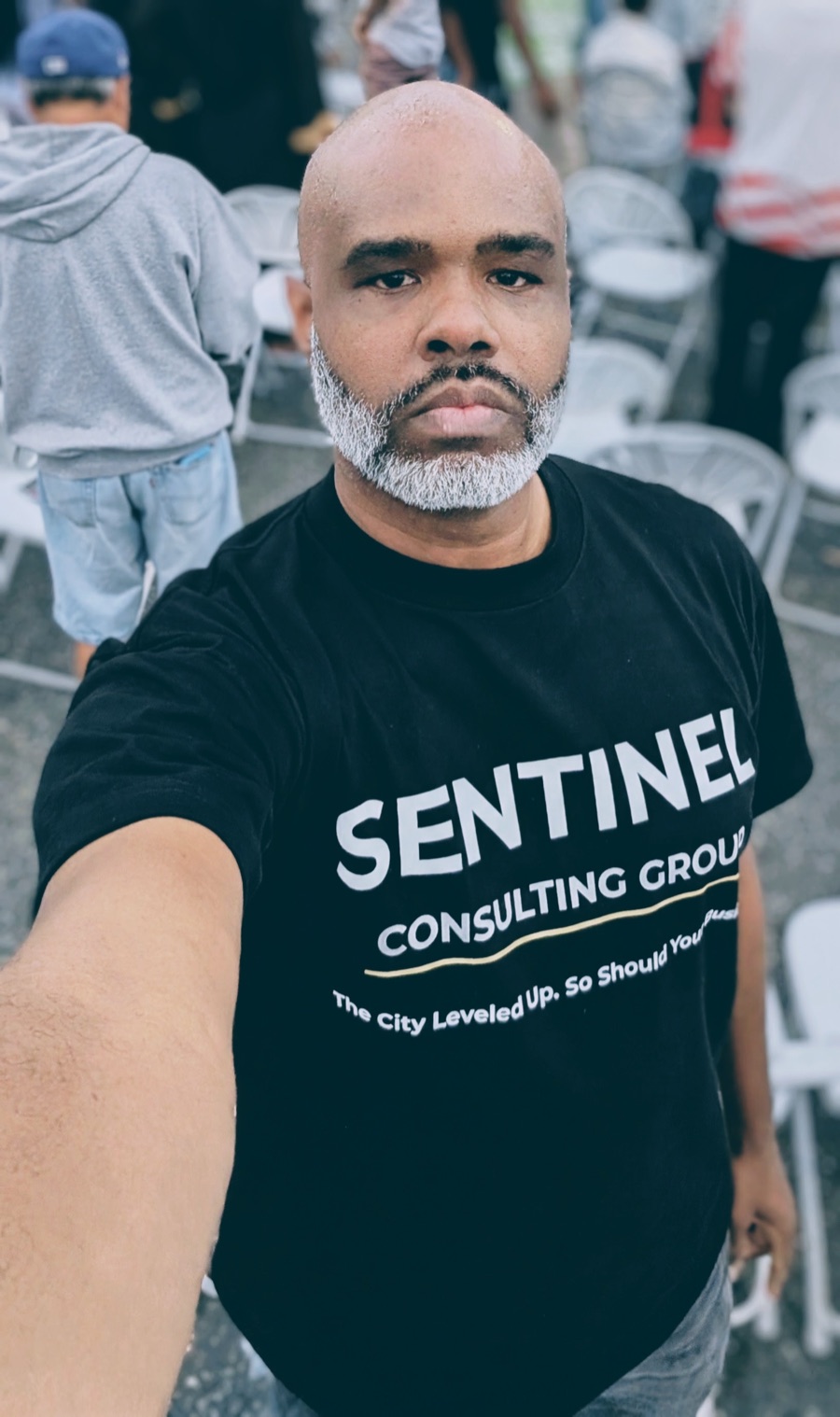
The Inglewood High mascot is the Sentinel — someone who stands at the gate and protects what matters. That is not borrowed branding. It is the most accurate word I have for what I’m trying to do here.
I want to be a pillar in this community and a beacon of what progress can look like when it comes from inside a neighbourhood instead of arriving from outside it. Not a consultant who commutes in. Somebody who was already here.
02 · What’s Actually At Stake
If we don’t learn this,
somebody else will.
I want to give you the real numbers rather than a warning, because the numbers are more persuasive than anything I could say about them.
of firms with 250 or more employees are using AI in production — against under 20% of the smallest firms. The companies with the most resources are also moving fastest.
US Census BureauHere is the number that actually matters. 89% of small businesses say they use AI now — but only 14% have it genuinely built into how the business runs. Almost everybody is dabbling. Almost nobody has installed it.
US Chamber of Commerce, 2026What that gap means on our block
A chain restaurant opening near SoFi has a marketing department, a booking system, a reviews process, and somebody whose whole job is making sure they show up first when you search. The family place two doors down has none of that, and until recently there was no version of the world where it could.
That was a fair fight to lose. You can’t out-hire a corporation. But the reason that gap existed was never talent or work ethic — it was payroll. And payroll is exactly the thing these tools just made optional.
The honest risk
The businesses that kept this neighbourhood alive through the years nobody wanted to be here are the ones with the least time to figure out new software. They are working. They are not reading about AI.
So the danger is not that AI replaces them. It is that the money arriving in Inglewood over the next three years flows to the businesses that were ready for it, and the ones who earned the right to that money get watched from the sidelines again. That is the thing I am actually trying to prevent.
03 · The Other Side Of It
And if we do learn it,
the numbers are absurd.
This is the part I genuinely believe, and the reason I built this whole business. The gap between a one-person operation and a company with a department has never been this small.
Generated by 29.8 million one-person businesses in the US — 6.8% of the entire economy, produced by people working alone.
Solopreneur data, 2026One-person businesses that crossed a million dollars in revenue in a single year. No staff. No office. No investor.
US business filings, 2023Of new startups now have a single founder, up from 23.7% in 2019. The team you used to need to raise money for, you can increasingly just run.
Startup formation data, 2025Roughly what a full solo stack costs per month — the writing, the design, the content, the automation. That is the entry fee now. It used to be a payroll.
Industry tooling averages, 2026You can take an idea, build it into something real for close to nothing, and then use the same tools to figure out how to market and sell it. That was not true five years ago. It is true right now, and most people have not noticed yet.
Why I do this04 · Why Me
I want to watch
you win.
That is not a slogan and I know how it sounds. But I have spent twelve years being the person who makes somebody else’s vision happen and then watches them take the bow, and I found out I actually like that job. I am not trying to be the star of your business. I am trying to make sure your business works.
I also live this. I am running the creative side-hustle life right now — the products, the content, the client work, the thing you do at night after the thing you do all day. When I tell you the math on your side income, I have run that math on my own.
I believe AI can level the playing field between a neighbourhood business and a national one, if it is set up properly. That last part is the whole job. Handing somebody a tool is not help. Installing it into how they already work, in a way that survives a busy Saturday, is help.
And I want to be a pillar here. Not a consultant with an Inglewood zip code on his business card — someone this city can point at and say that is what progress from the inside looks like. If that sounds like a lot to put on a small consulting firm, it is. I would rather aim there and fall short than aim lower and hit it.
Every good idea dies
in the logistics.
Most ideas do not fail because they were bad. They fail because nobody handled the unglamorous middle — the systems, the follow-up, the pricing, the thing that had to get done on Tuesday while the founder was busy being inspired.
That middle is what I am good at. Thirteen years of military logistics and six years of making film productions physically possible is one long apprenticeship in turning somebody else’s vision into a thing that actually happens on a schedule.
So if you have an idea and no operator — a product, a service, a venture you have been carrying around for two years — that is a conversation I want to have. Not as a vendor you hire by the hour. As the person who builds the machine underneath it.
What I actually bring:
- Systems that run without you standing over them
- Logistics — the part where plans meet reality and usually lose
- Customer relations, from six years of walking in cold and getting a yes
- AI implementation that survives a busy week, not a demo
- Brand, content, and the machine that markets the thing
- Straight answers about what will not work, before you spend money on it
I am open about the shape this takes — a partnership, equity, a long engagement, a retainer. What matters more is whether the idea is real and whether we can work together. Tell me what you are building.
06 · Start The Conversation
Tell me what
you’re building.
A business, an idea you have not started, a project that stalled, or a job you think I would be right for. I read every one of these myself and I answer honestly — including when the honest answer is that you do not need me.